Attractive Workplaces: How Building Within Existing Contexts Creates Future-Proof Workspaces
Existing Buildings with a Future: How a Consistently Converted Office Building in Düsseldorf is Becoming a Blueprint for Modern Working Worlds – with Light, Structure, and New Spatial Logic.
New Work Reimagined Within Existing Contexts – Through Flexible Spatial Structures, Participatory Planning, and Architecture that Combines Interaction and Concentration
In recent years, the role of the office has changed fundamentally. While it used to be a fixed place for daily commuting, it is increasingly becoming a place for exchange, inspiration – and voluntary attendance. The pandemic initiated processes that require a new spatial logic. Anyone who wants to inspire employees to return to the office permanently needs more than ergonomic desks and good coffee machines. It requires a New Work concept that fosters community, provides orientation, and promotes meaningful interaction.
Renovation Instead of Relocation: The Decision to Build Further
The financing company DLL also faced this challenge. The option of changing locations was intensively examined – in the end, the choice was made to preserve and transform the existing building in Düsseldorf. The decision to build within the existing context was also a commitment to the building’s substance: instead of demolition or relocation, a renovation was decided upon that fundamentally reinterprets the building.
Together with the architecture firm CSMM, a working world was created on approximately 3,800 m2 that rethinks the coexistence of retreat and communication. The planning began with an unusually participatory process: in interdisciplinary workshops, around 30 employees from different departments developed the foundations for the spatial program. This collaborative approach forms the foundation of a design that understands user experience as an add-on and not just a starting point.
Transformation: Rhythm, Structure, Identity
The spatial transformation was deliberately realized in stages. While one floor was still in use, the other was gutted and restructured – a concept that required high levels of coordination. The old floor plan gave way to open, multifunctional zones. Existing glass elements were integrated to bring transparency and daylight into the center. New materials and geometrically soft-drawn forms deliberately contrast with the rigid building structure.
A clear wayfinding concept with floor markings and signage based on Düsseldorf’s urban spaces provides orientation. Meeting rooms are not anonymously numbered, but named – a simple measure with a great impact on the atmospheric legibility of the place.

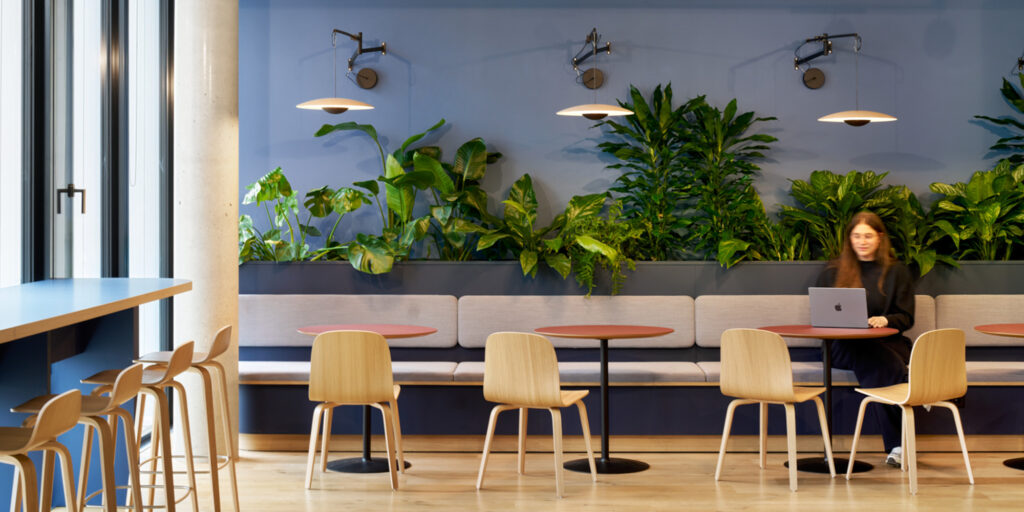
Hybrid Work Requires Clear Zones
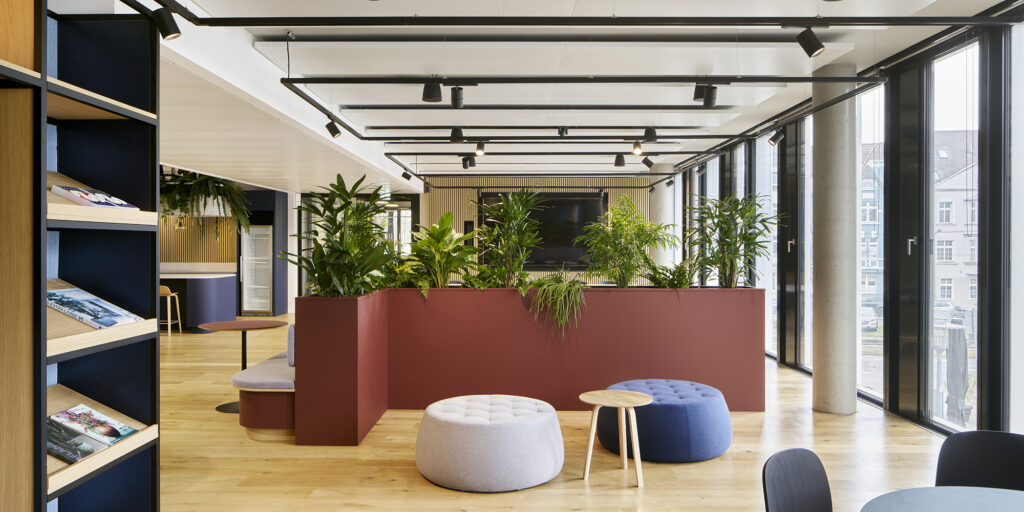
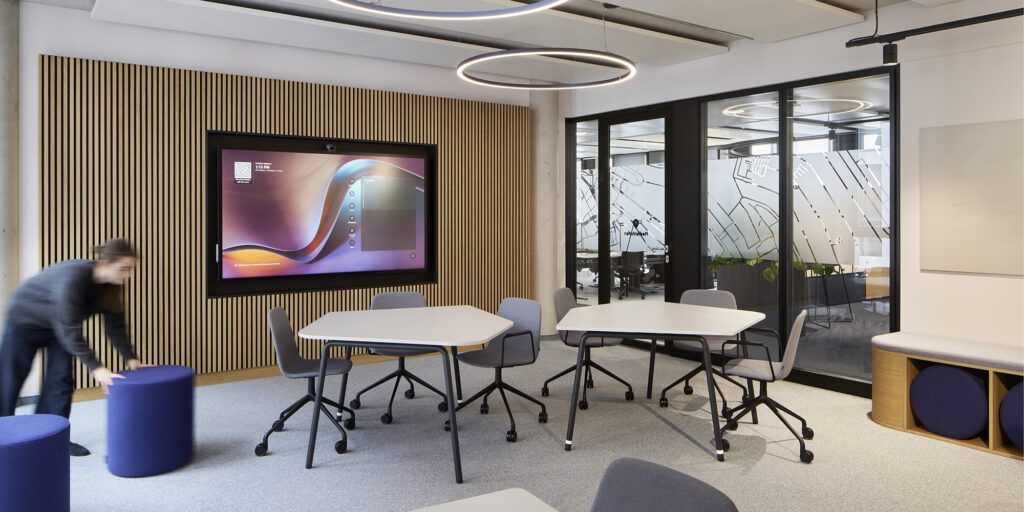
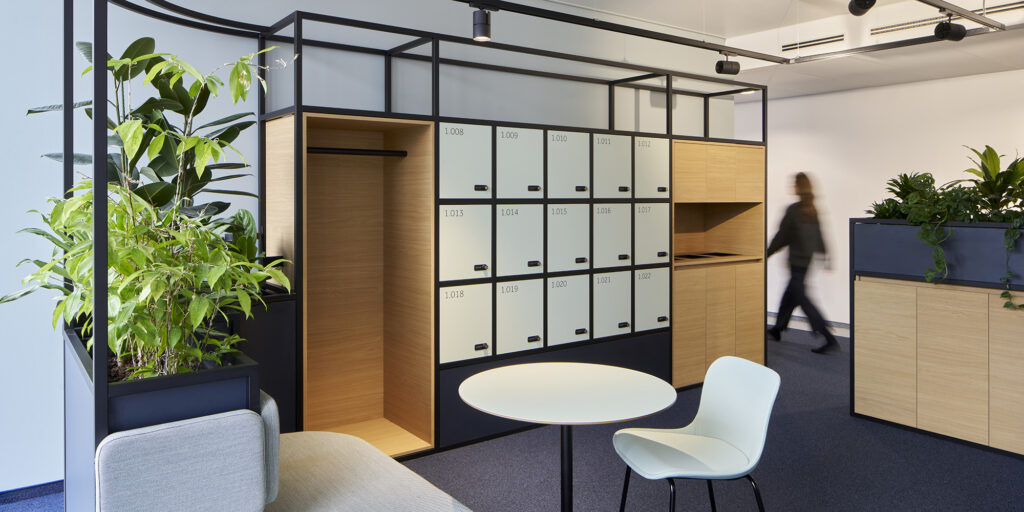
In order to structure hybrid work meaningfully in everyday life, so-called “home zones” were introduced for teams. This is supplemented by fixed anchor days and generous lounge areas. The “Carlsplatz” – an open meeting area in the center – forms the communicative heart. Presentations, lunch, or spontaneous events: the zone is not programmed; it is designed to be open. A large media wall supports digital formats as well as hybrid meetings with international partners.
Light and acoustics were understood as design elements from the very beginning. The visible light track system with spotlights deliberately stands out as a design element. In combination with a precisely coordinated acoustic concept, an environment is created that allows for concentrated work as well as spontaneous interaction.

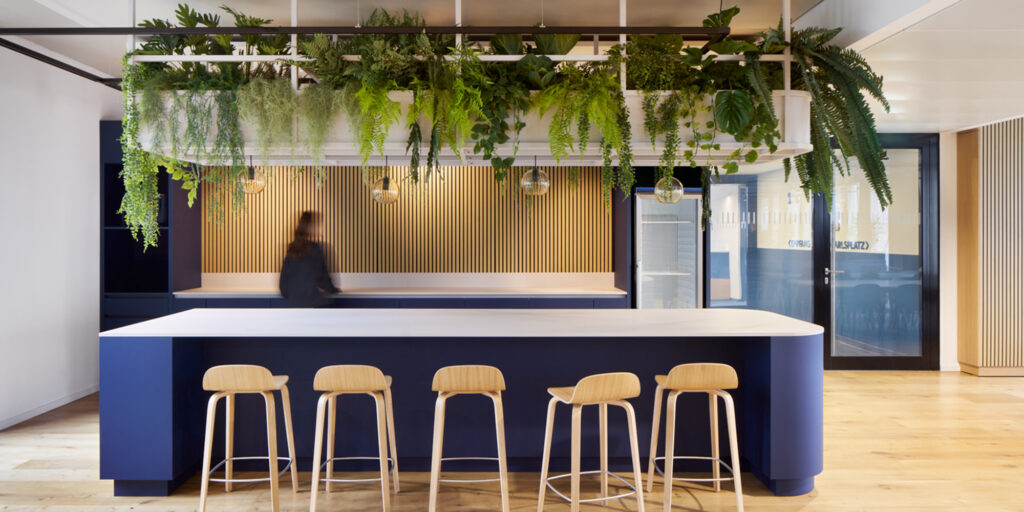
Building Within Existing Contexts: An Opportunity for Identity Formation
What is succeeding in Düsseldorf is not an isolated case – it is exemplary of an attitude toward dealing with existing buildings. Renovation and building within existing contexts is seen less as a compromise and more as an opportunity for further development. Instead of replacing spaces that have aged, they are transferred into a new narrative. It goes far beyond revitalization in a technical sense – it is a cultural transformation. The office as a place of belonging in the sense of New Work: if this succeeds, a working environment is created that brings people back without compulsion. And in the long term, it is more than the sum of its functions.

You might also be interested in
SCHULBAU Fair
SCHULBAU Essen 2025 – Successful industry meeting for educational construction
Impulses, Lifestyle
WEtransFORM in Bonn: Exhibition outlines visions for sustainable construction