Brainergy Hub Jülich: Timber hybrid, breathing façade, LowEx – a rotunda as a social engine of the energy transition
Brainergy Hub Jülich: HENN’s circular new building organises co-working, research and exchange in a park landscape
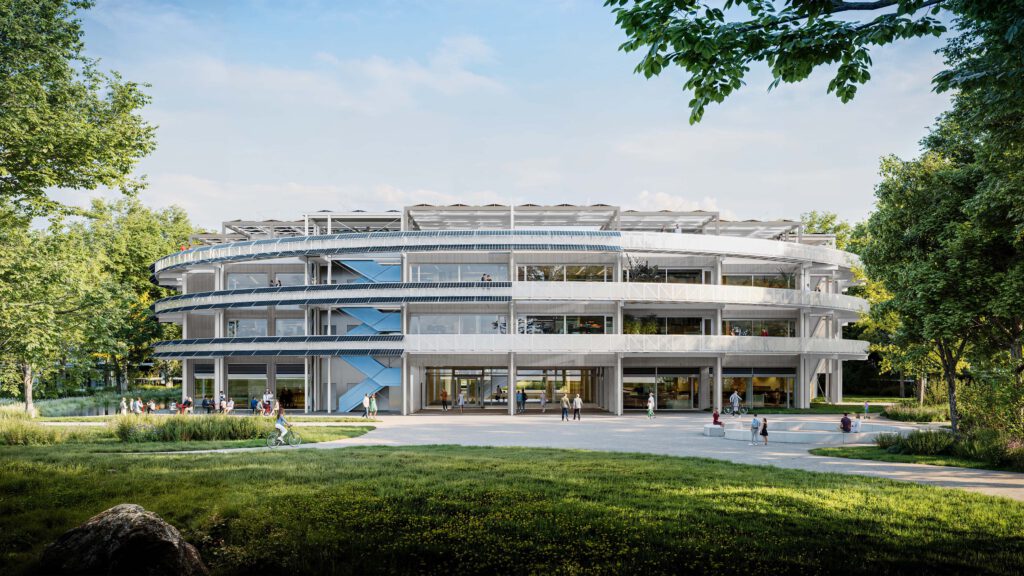
The energy transition needs spaces and clear images for it. Where transformation policy meets everyday life, places that enable community, bundle knowledge and conserve resources are convincing. In Jülich, a concise building block is being created for this purpose: the Brainergy Hub. The circular new building will become the social centre of an entire energy park – as a place of work, exchange platform and identity-creating figure for a region on the move. Completion is scheduled for 2027.
Knowledge hub in the energy park
The Brainergy Hub will be the heart and address of an area that will attract companies and start-ups from renewable energies, bioeconomy and digitalization. The architecture of HENN makes the program legible: a rotunda with equal orientation in all directions, anchored in a park landscape. This is where people meet to work, present and communicate.
Circle as a principle – grid as a tool
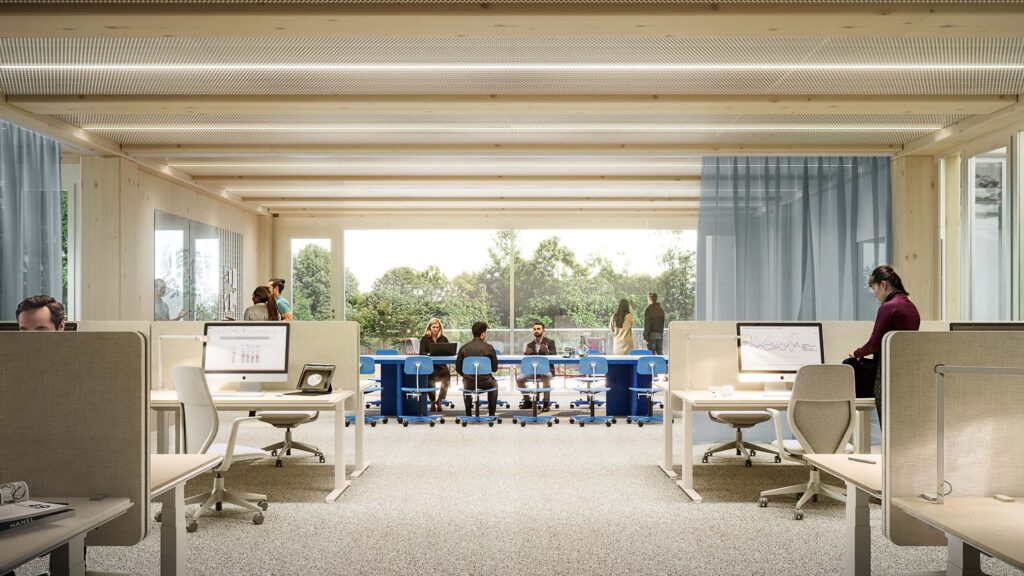
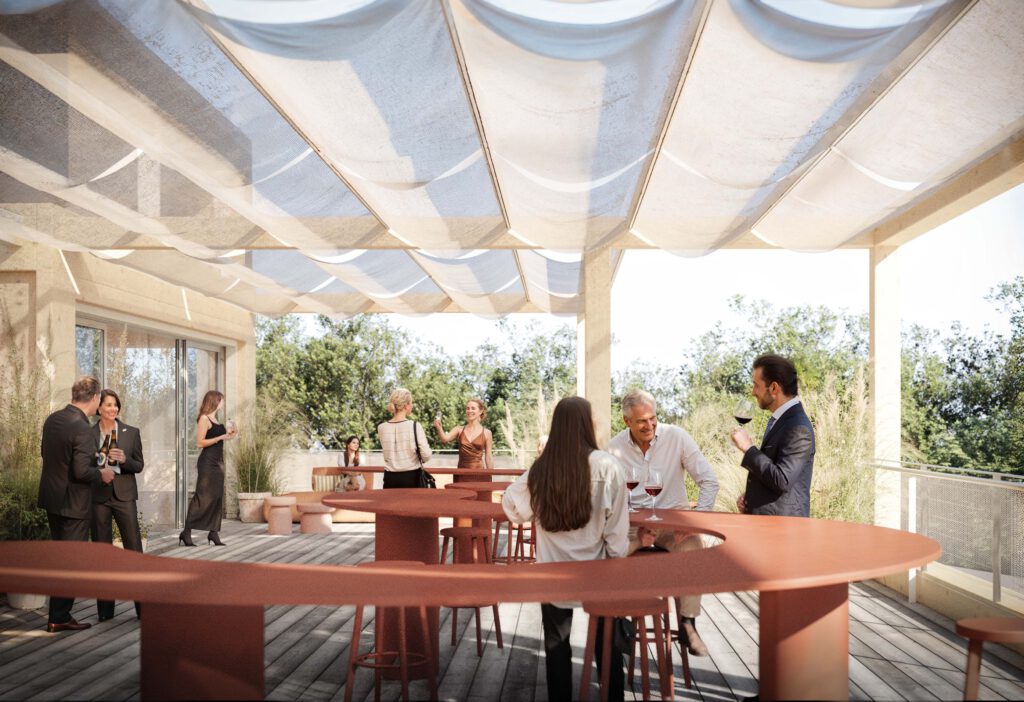
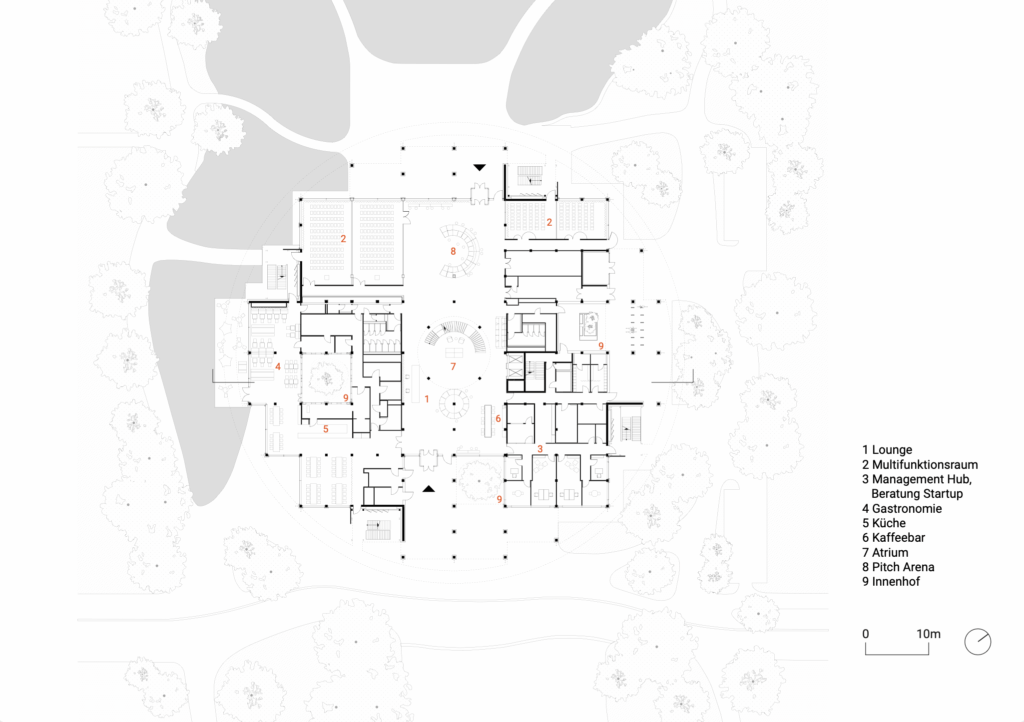
Inside, a modular system organises the uses: on the upper levels, a “pixel cloud” of office units is formed, enclosed by three circumferential balcony rings. In between, inner courtyards and a spacious atrium will be created, which will bring daylight deep into the building and open up a variety of pathways. External stairs allow shortcuts, the ground floor moves back and aligns a clear north-south axis that connects the lake and orchard on the property. Event rooms with terraces await you on the roof.
Wood hybrid that creates atmosphere
In terms of construction, the design relies on a wood-concrete hybrid structure. Wooden supports and beams remain visible, interiors are given wooden cladding. This creates warmth, robustness and a haptic quality that fits the programmatic idea: concentrated work, spontaneous discussions, joint development. For the project, the CO2 balance is considered throughout – bound carbon including operation – and used as a basis for decision-making. The aim is to obtain a DGNB certificate in gold.
Façade, climate, energy – a finely balanced system
The building envelope plays an active role in the climate concept. Decentralized, “breathing” façade elements alternate between supply and exhaust air, ensure high air quality and, according to planning, achieve up to 90 percent heat recovery. External sun protection reduces heat input. Inside, heating and cooling panels complement the control system, and at night the system cools the storage masses. Electricity is generated by photovoltaic modules on the roof and in the access rings; Surpluses flow into an energy storage system in the house. The hub obtains heat and cold from the park’s LowEx local heating network with heat pumps as a pacesetter.
Landscape and water balance as players
The hub is located in a diverse park landscape. Green spaces and biotopes counteract urban heat effects, green roofs and inner courtyards create additional habitats. A newly created lake serves as a retention basin for the rainwater of the entire park. The building also uses rainwater in operation. Architecture, open space and water balance are intertwined to form a robust, low-maintenance system.
Interior design: workshop spirit and clear orientation
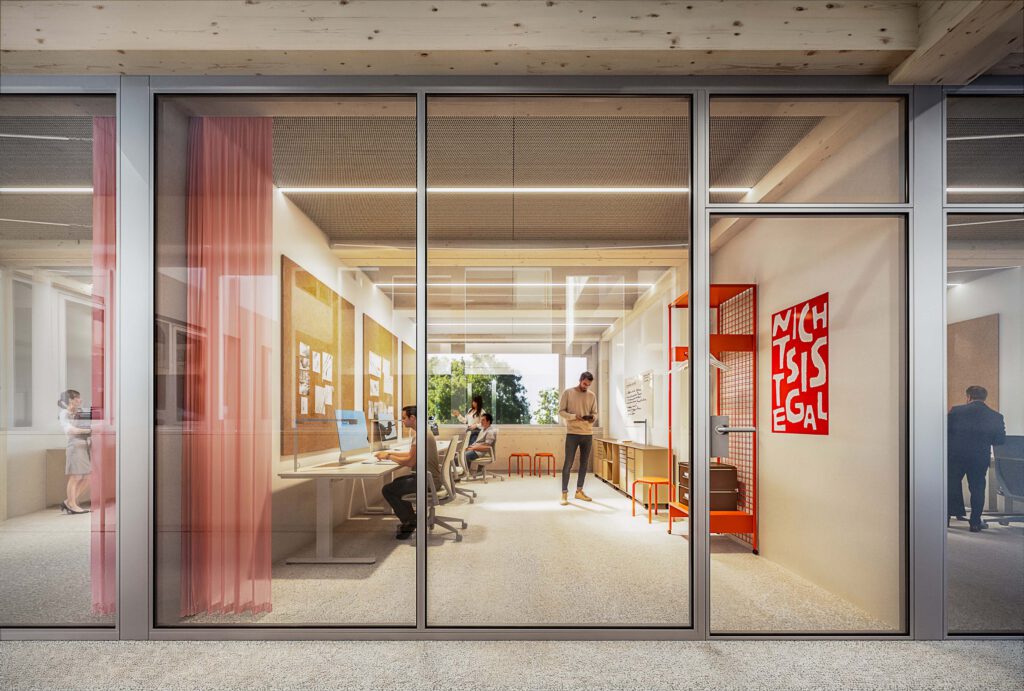
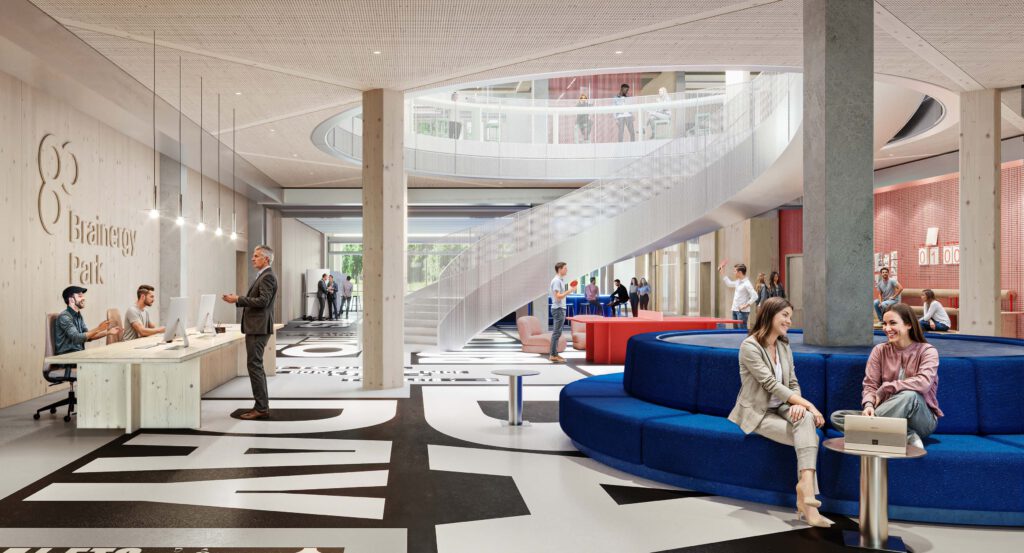
The interior transfers the circular idea from the macro to the micro level: modular furniture made of circular segments, expansive seating landscapes in the foyer, round stools and flexible tables. Visible wood structures, unclad technology, functional metal surfaces and robust components made of plywood and recycled material create a workshop atmosphere that invites active use. Colour worlds zone, strengthen identity and facilitate orientation; the typography in the floor, designed by the Uebele office, combines a guidance system and a poetic level. Four office units are grouped around the central spiral staircase with open work areas, smaller offices and meeting and workshop zones. On the ground floor, the foyer forms an address-forming central axis, including a “pitch arena” for presentation and exchange.
Why this is important for educational construction
The Brainergy Hub is an example of learning and working environments that take collaboration seriously. The ring as a spatial figure promotes encounters, the shell takes over the tasks of the technical building equipment, open space and water activate resilience. The project provides suggestions for campus and school buildings : modular usage clusters instead of rigid corridors, breathing facades with decentralised ventilation, clear ground floor zones as commons, stairs as social links, roof areas as third levels. The draft thus functions as a blueprint for how knowledge spaces of the energy transition can be thought of programmatically and climatically, from co-working to workshop pedagogy.
Construction board
- Project: Brainergy Hub
- Location: Jülich, Germany
- Typology: New construction
- Client: Brainergy Park Jülich GmbH
- Architecture: HENN
- Scope of work: LP 1–9 HOAI, object and general planning, interior design
- Landscape architecture: Latz + Partner
- Structure / TGA: Büro Happold GmbH
- Building physics / acoustics / media planning: Müller BBM (thermal insulation, building and room acoustics, media planning)
- Fire protection: hhp Berlin
- Façade: Brave New World Engineers
- DGNB certification: Kempen Krause Ingenieure
- Kitchen planning: K & P Planungsbüro GmbH
- IT technology: ComConsult
- Media planning: hmpartner
- Signage: Office Uebele
- Land area: 39 400 m²
- Gross floor area (GFA): 9 700 m²
- Dimensions: diameter 73 m, height 18 m
- Floors: 1 basement, 4 upper floors
- Workplaces: approx. 300
- Competition: 2021
- Start of construction: 2024
- Completion (planned): 2027
- Sustainability: DGNB Gold (targeted)
You might also be interested in
SCHULBAU Fair
SCHULBAU Essen 2025 – Successful industry meeting for educational construction
Architecture, SCHULBAU Fair
Gustav Heinemann Comprehensive School Essen: How architecture accompanies change in the neighbourhood