Thomas Mann Gymnasium in Munich: Compactly built, conceived as open
The new Thomas Mann Gymnasium in Munich by h4a Architekten densifies urban space while setting new benchmarks in school design – with a rooftop sports ground, open learning forums and a bicycle garage right in…

Layered learning: The new-build of the Thomas Mann Gymnasium
As cities grow, so does the need for educational facilities. In densely built urban districts such as Munich-Obersendling, school construction becomes an urban-planning challenge – and an architectural design task. Because today, educational spaces are expected to do far more than simply enable teaching. They should open up, provide structure, offer support – and deliver answers to changing learning in the 21st century.
Such a model for the future has been taking tangible shape in Munich since autumn 2024: the new Thomas Mann Gymnasium, realised by h4a Gessert + Randecker Architekten, is more than a school building. It is a densified learning biotope on around 1.4 hectares that relates in scale and attitude to the urban context while also pointing to new directions in school design.
School as an urban building block
Rather than separating itself from the neighbourhood, the design develops the school site along the block edges. The architects deliberately reference the industrial surroundings, enclose the plot with a semi-transparent perimeter, shield it acoustically and thus create a protected educational space within. The internal organisation follows the City of Munich’s learning-house principle – and is bundled into compact spatial figures on the tight site.
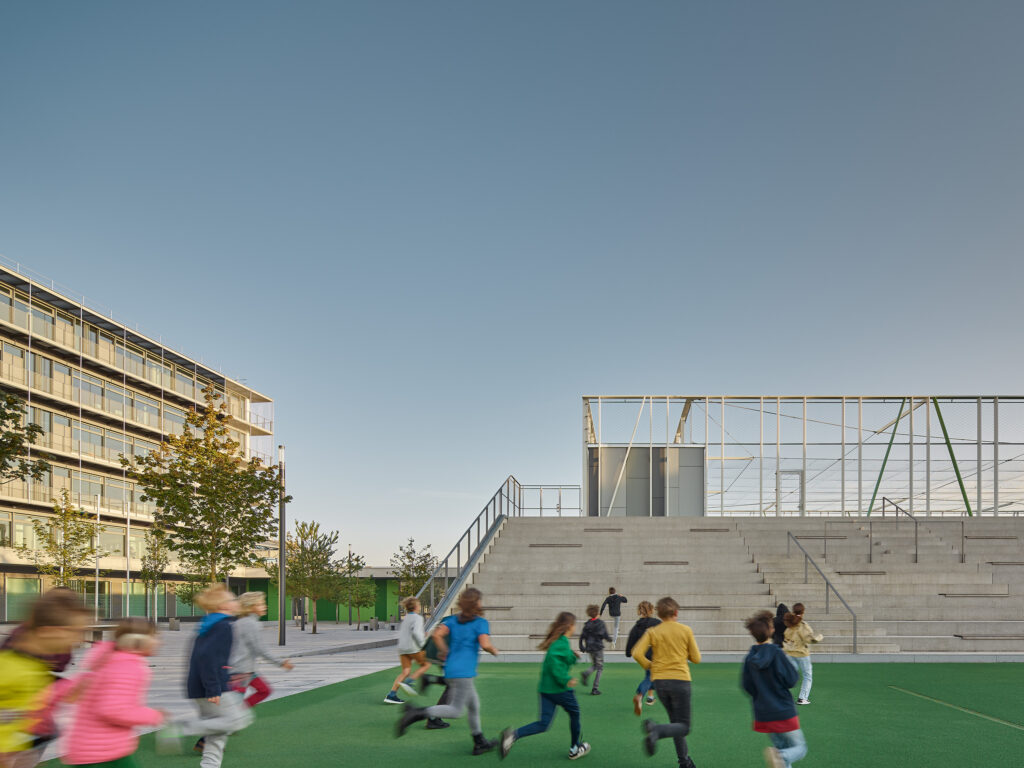
A clear response to the challenges of densified metropolises: build compactly, distribute efficiently, think multifunctionally. The auditorium, specialist classrooms, library, canteen and administrative areas are integrated, as are a covered sports courtyard, a sports hall with grandstand and an all-weather pitch on the hall roof.
Architecture as a pedagogical tool
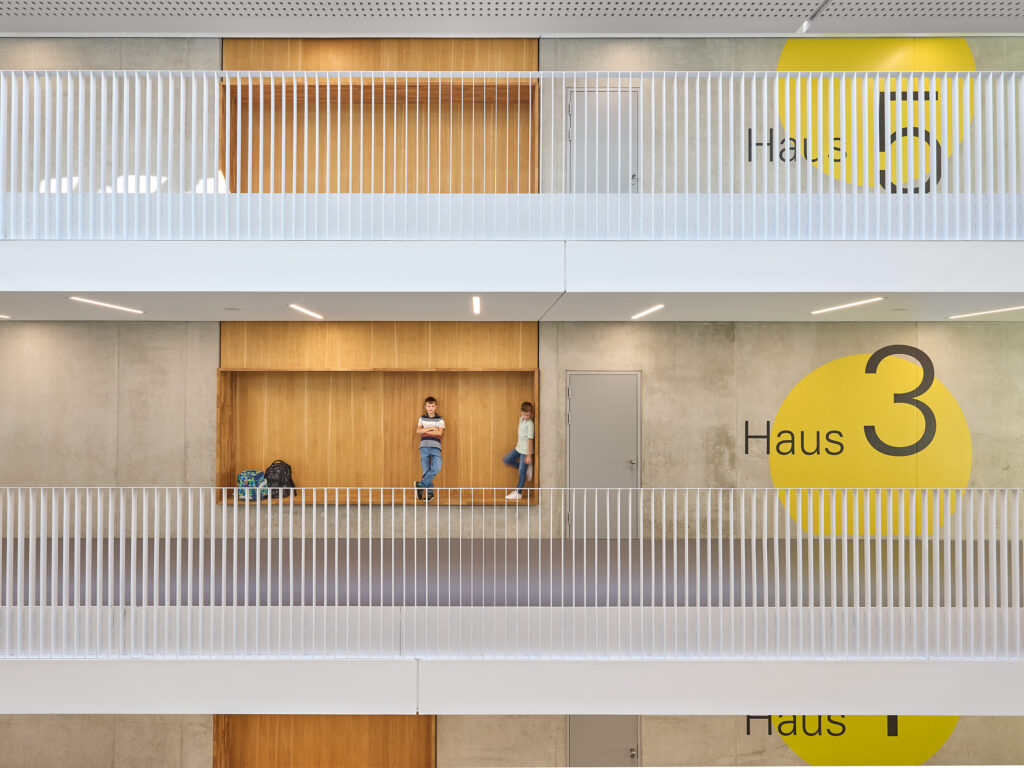
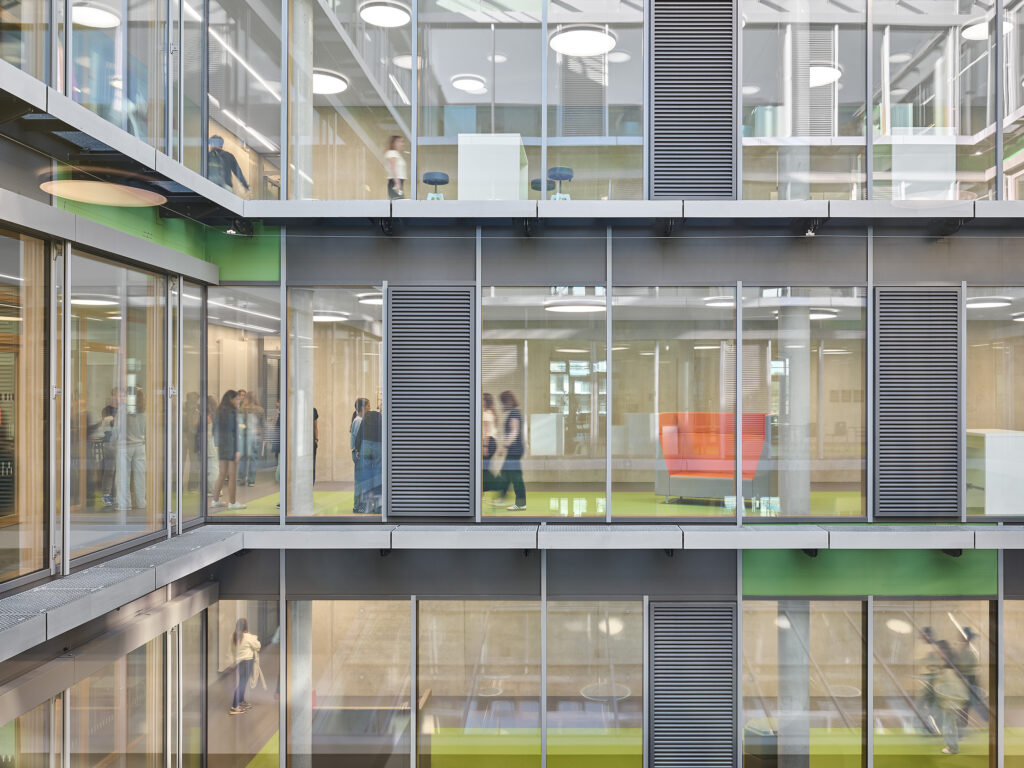
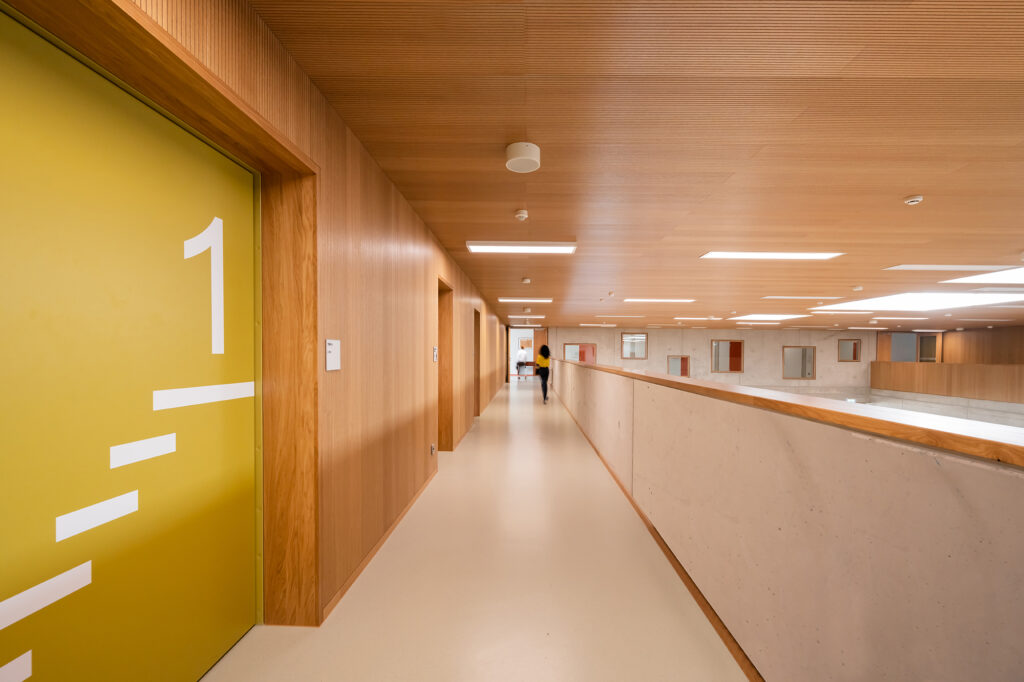
The school design relies on a finely grained differentiation of learning spaces. On the upper floors, smaller units are organised around open forums, complemented by inclusion and breakout rooms. The permeable structure creates zones for self-directed learning and alternative teaching formats.
A central atrium runs through all five storeys, opening up sightlines upwards and providing daylight – an architectural element that not only offers orientation but also fosters a sense of community. The learning spaces connect to this heart of the school, interlocking with the forum and the courtyard, with the sports and creative areas.
Structured outdoor space for active interaction
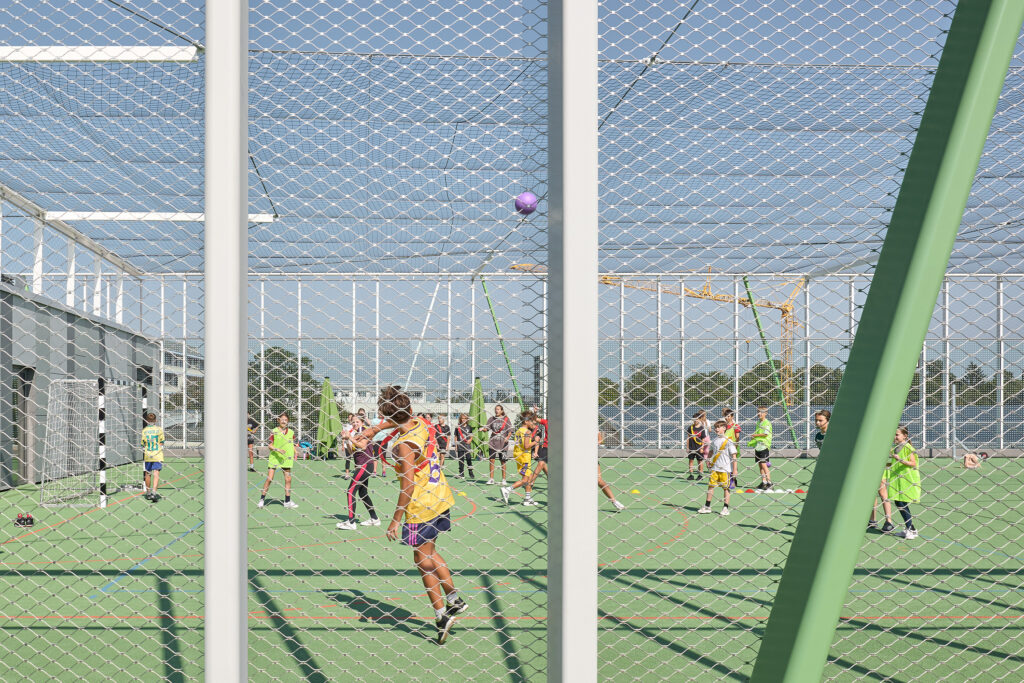
What at first glance appears to be a functional school site reveals itself, on closer inspection, as a carefully composed spatial network. Sports areas, meeting zones, seating terraces and a sculptural stair structure form a rhythmic outdoor space that structures everyday life – while also functioning as a space for movement.
The sports hall itself is connected to the art and creative rooms via a sunken courtyard; the roof serves as a break area with an all-weather pitch. During breaks, this “cage”, as the pupils call it, becomes a stage for spontaneous joy of movement.

Technology meets attitude
Inside, the spatial design is paired with targeted technical equipment. Interactive whiteboards in every classroom, two computer rooms per level, state-of-the-art science labs: the planning translates pedagogical objectives into spatial reality.
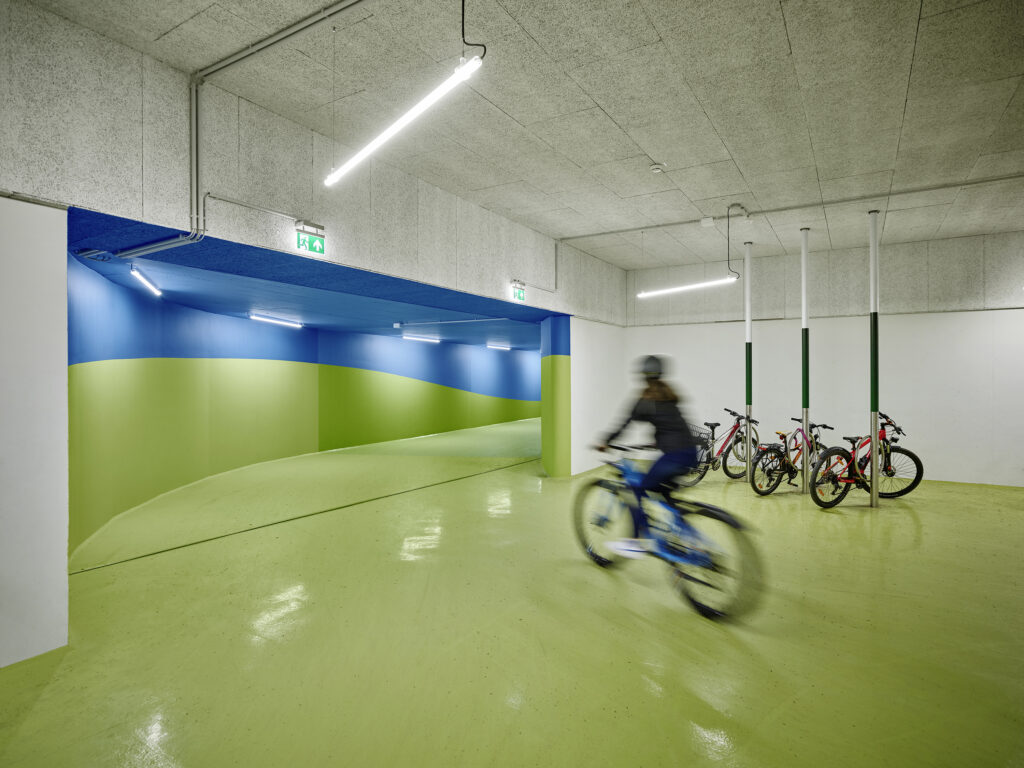
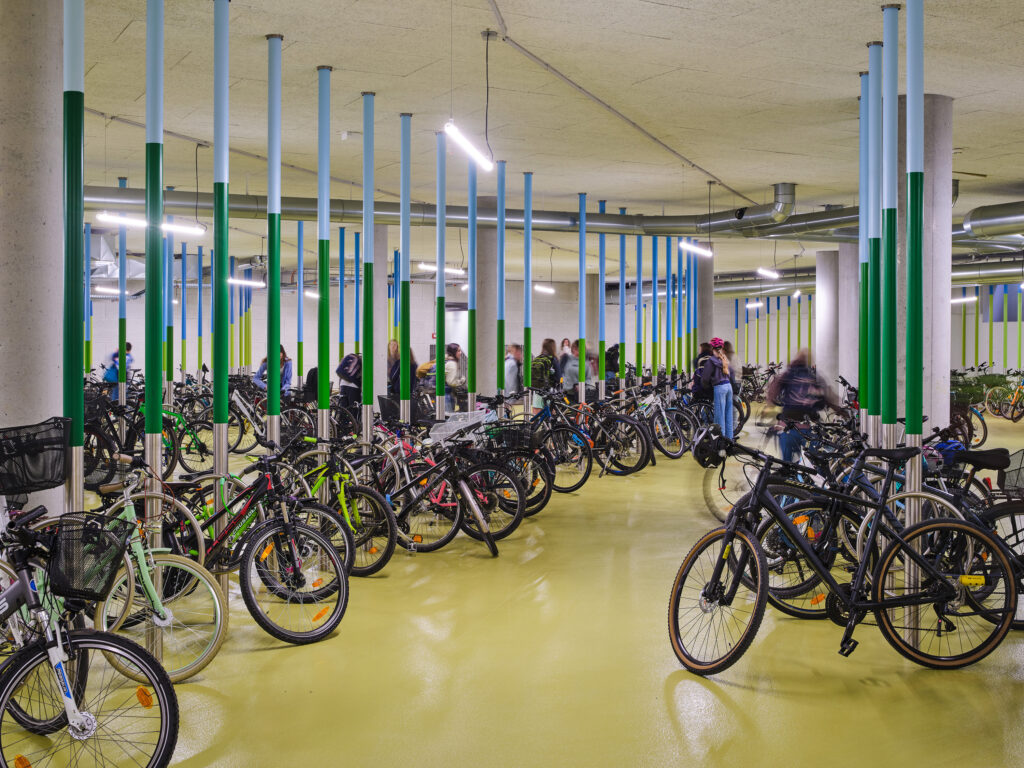
Particular attention is paid to sustainable mobility. Via a landscape-architecturally designed ramp, pupils reach a bicycle garage for up to 450 bicycles – a clear commitment to a climate-friendly city.
A building for up to 1,600 young people
The new Thomas Mann Gymnasium becomes a place for education, encounter and movement. The various pedagogical profiles – from wind ensemble class to theatre to STEM – are reflected in the diversity of spaces.
Architecture, space and pedagogy interlock. The school building does not appear as a standalone object, but as a social offering: a place that creates space for what school must – and wants to – achieve today.
Project Details
- Client: City of Munich, Department of Education and Sport
- Architect: h4a Gessert + Randecker Architekten
- Construction supervision: Köhler Architekten + beratende Ingenieure GmbH, Munich
- Location: Gmunder Straße 45, 81379 Munich
- VgV procedure: 2016, 1st prize
- Planning/construction period: 2016–2024
- Completion: 09/2024
- GFA: 26,250 m2
- BRI: 116,311 m3
- Project management: HWP Planungsgesellschaft, Stuttgart
- Landscape design: realgrün Landschaftsarchitekten, Munich
- Structural engineering: bwp Burggraf + Weber Beratende Ingenieure, Munich
- Fire safety: Christian Steinlehner, Munich
- Building services (HLS): Ingenieurbüro Konrad Huber, Munich
- Electrical: Schuster Buchner Schmid, Hohenlinden
- Building physics: Ingenieurbüro Hausladen, Kirchheim
- Kitchen planning: F&B Promotion, Gilching
- Art: Atelier Georgia Creimer, Vienna
- Photography: Zooey Braun, Stuttgart / Günter Richard Wett, Innsbruck / Olaf Becker, Munich

You might also be interested in
SCHULBAU Fair
SCHULBAU Essen 2025 – Successful industry meeting for educational construction
Architecture, SCHULBAU Fair
Gustav Heinemann Comprehensive School Essen: How architecture accompanies change in the neighbourhood