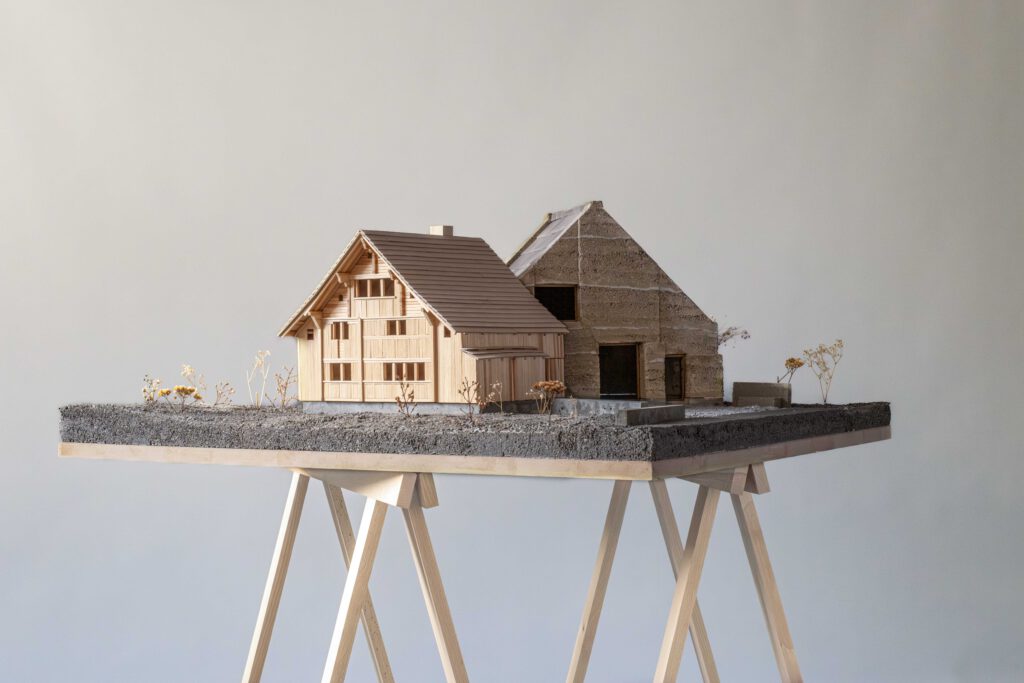
On-the-Go School: How mobile learning is rethinking school
On-the-Go School: Interview with Florian Nohl on mobile learning, spatial concepts and pedagogical freedom Educator Florian Nohl talks about the concept of the On-the-Go School—a mobile form of education that brings learning into everyday life…
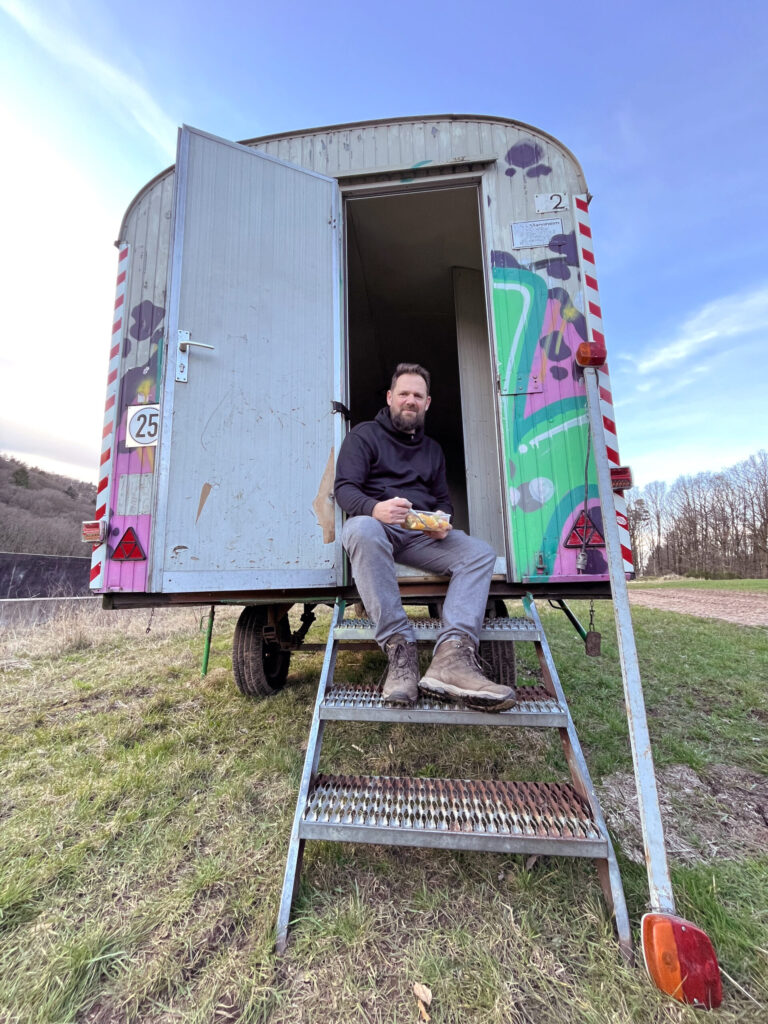
Learning outside the classroom –
this is what the On-the-Go School pursues as a pedagogical approach. At regular intervals, it relocates its site in order to embed learning processes in real-world contexts. In the interview, school development specialist and educator Florian Nohl talks about the idea behind the concept, mobile spatial structures, participatory processes, and the challenge of making school construction mobile in the literal sense.
SCHULBAU: How did the idea of the On-the-Go School come about, and which pedagogical concepts underpin this project?
FLORIAN NOHL: The idea emerged from my many years of work in school development and from travelling to schools portrayed in Reinhard Kahl’s film “Greenhouses of the Future”. As a headteacher, together with the staff I transformed a Realschule into a comprehensive school with inclusion and project-based learning. After a personal change, I asked myself where learning really takes place. The most important learning experiences often happen outside the traditional school building—on excursions and school trips. That is how the idea arose to create a school that moves to a new place every five to six weeks in order to learn in context.
SCHULBAU: How does the modular construction influence the design of the spaces and the pedagogical possibilities within the On-the-Go School?
FLORIAN NOHL: The modular construction of the yurts creates functional yet flexible spatial constellations: two connected yurts provide space for group work as well as presentations. The spatial design is multifunctional and kept simple, enabling rapid adaptation to different learning activities. Minimal furniture and the option to learn outdoors promote freedom of movement and the On-the-Go School’s central aim: to design learning as context-based and experience-oriented.
SCHULBAU: Mobile learning spaces also sound like a challenge. How do you address these in planning and implementation?
FLORIAN NOHL: There are many challenges. We have to find suitable locations and make them work, which requires a great deal of time and coordination—especially regarding safety and the children’s learning progress. These concerns must be taken seriously. It is also important to address communication and the involvement of all stakeholder groups. In addition, it is about arguing against the system conformity of many teachers, who are often safety-oriented. This requires courage to take new paths and to consistently justify what matters in learning.
SCHULBAU: How is flexibility of the learning environment taken into account when planning the On-the-Go School in order to meet the different needs of students?
FLORIAN NOHL: There is no single type of student—there are different learners shaped by their prior experiences and current life situations. Different interests require a diverse offering and suitable learning opportunities. By changing learning locations and using modular construction, a rich and adaptable learning environment is created that can meet individual needs.
SCHULBAU: And what about mobility—what technical and logistical measures do you take to be able to operate the school at different sites?
FLORIAN NOHL: Mobility is part of the concept—not only logistically, but also as a learning tool that teaches how to deal with change. In my view, it also matters that you work with natural materials that cannot be manufactured industrially, or only to a limited extent. Spaces must enable certain functions: you need to be able to work quietly on your own, use different seating positions, work collaboratively and present. Above all, however, you need to be able to engage in conversation—that is the most important thing.
SCHULBAU: Which brings us to sustainability: How is this ensured in implementing the project, and which environmentally friendly materials and technologies are used?
FLORIAN NOHL: The yurts are made of locally sourced Douglas fir and sheep’s wool, making them durable and environmentally friendly. Insulation is provided using sustainable materials; recycled materials such as truck tarpaulins are planned for the exterior. The yurts are produced regionally in the Odenwald by a yurt builder who values local value creation. Energy is to be secured through solar panels and wood-burning stoves, encouraging a conscious use of resources. We also rely on environmentally friendly solutions such as urine-diverting toilets for toilet use.
SCHULBAU: How is collaboration with local communities and authorities organised to ensure the On-the-Go School runs smoothly?
FLORIAN NOHL: Collaboration is achieved through early involvement in the planning process. Regular presentations and discussions on site promote understanding and acceptance of the project. In the long term, a network of schools and communities is to be established to support the idea of the On-the-Go School. These partnerships help to obtain the necessary resources and permits.
SCHULBAU: To support and expand learning, you also use digital technologies and modern means of communication. Where are these used?
FLORIAN NOHL: Digital media enable the documentation and presentation of learning experiences, data exchange, and collaboration between learners and teachers. Tablets and apps help to deepen learning content and broaden access. At the same time, care is taken to regulate the use of digital media and to encourage students to engage intensively and consciously with real learning environments.
SCHULBAU: How is the quality of teaching and the learning environment regularly evaluated and ensured?
FLORIAN NOHL: Evaluation means keeping a systematic approach in mind and preparing activities in a targeted way. Learning processes should not be left to chance. Within the staff, curricular work is required and it must be discussed what forms of evidence of learning will look like. A broad range of evidence of learning is important, and quality must be ensured. This means that teaching should not only promote reproduction, but also higher cognitive skills such as evaluation and analysis. Traditional measurement instruments are often unsuitable. We need a concept that also strengthens social processes and actively involves students.
SCHULBAU: What long-term goals are you pursuing with the On-the-Go School, and what are your visions for the future of this project?
FLORIAN NOHL: In the long term, the On-the-Go School is intended to serve as a text-based learning environment. The aim is to make learning an active, experience-based process that goes beyond the boundaries of traditional school buildings. The vision includes not only the wider dissemination of the On-the-Go School, but also concepts such as a network of partner schools. It is also about involving universities and higher education institutions in this process. In this way, learning as a whole is to be changed and improved.
SCHULBAU: Can students still be given a sense of stability and continuity in a mobile learning environment?
FLORIAN NOHL: The group plays a central role. In a mobile learning environment, you have to engage intensively with the learning group. Trust and active participation are crucial. A fixed space does not necessarily have to be a traditional school building; a community hall would also be possible. This is where shared rules and learning concepts are discussed and democratic processes are practised—between individualised work and collective thinking.

You might also be interested in
SCHULBAU Fair
SCHULBAU Essen 2025 – Successful industry meeting for educational construction
Impulses, Lifestyle
WEtransFORM in Bonn: Exhibition outlines visions for sustainable construction